Tadej Pogačar at Paris-Roubaix: when fuelling strategy decides the race on cobblestones
 On 13 April 2026, Tadej Pogačar, reigning world champion riding for UAE Team Emirates-XRG, lined up at Paris-Roubaix with a single objective: conquer 258 km of northern France’s toughest roads, including dozens of cobblestone sectors. He finished 2nd behind Wout van Aert after 5h16 of racing, three punctures and three bike changes. A high-intensity classic that perfectly illustrates how precision sports nutrition can be the difference between finishing strong and cracking on the Carrefour de l’Arbre.
What Pogačar’s nutrition team engineers for him is exactly what Ograal does for you: analyse your effort profile, your race duration, your actual intensity, and generate menus and fuelling strategies calibrated with precision. No need for a ten-person expert team — just the app.
From 60 to 120 g of carbohydrates per hour: the calibration rule
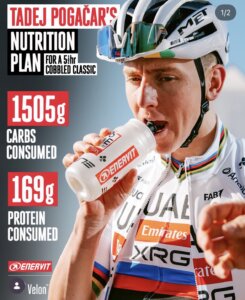
The cornerstone of Pogačar’s nutritional strategy rests on a simple but demanding principle: matching carbohydrate intake to effort intensity, hour by hour. Gorka Prieto-Bellver, UAE Team Emirates nutritionist, outlined the precise mechanics: at the start, the bottle contains 60 g of carbohydrates as Isocarb (Enervit, glucose:fructose ratio 2:1). Gels and bars are then added to reach 90–100 g per hour at full effort, with the final 20–30 g coming from solid food.
The 2:1 glucose-to-fructose ratio — Enervit’s C2:1PRO system — is far from a marketing detail. Scientific evidence shows it optimises intestinal absorption and avoids the saturation of carbohydrate transporters, delaying muscular fatigue (Jeukendrup, 2010, Sports Medicine).
On a summit-finish stage of the 2025 Tour de France, Pogačar consumed 460 g of carbohydrates over 5 hours on the bike — an average of 92 g/h — for a total daily intake of 6,000 kcal and 1,200 g of carbohydrates. These figures are possible only through a rigorous gut training programme carried out over several years. Pogačar himself says: “Five years ago, 120 g per hour was impossible — now there are no gastric problems at all.” If you want to build your own tolerance to in-race carbohydrate intake, a 6-week gut training plan to 90 g/h can transform your capacity to fuel without digestive discomfort.
Going from 60 to 90 g/h: the progression that changes everything
Most amateur athletes plateau at 40–60 g of carbohydrates per hour, often out of fear of digestive issues. It’s understandable: increasing the dose too quickly, without adaptation, causes exactly the nausea and cramps you’re trying to avoid. But progression is possible, gradual and well-documented. Going from 60 to 90 g/h without stomach issues is not reserved for professionals — it’s a question of method and patience.
For efforts lasting more than 2h30, multiple-carbohydrate products (glucose + fructose) are particularly effective. The Hydro Gel peach (x4, 53 ml) is a good example of a product suited to this strategy: hydrated format, pleasant taste, easy to take even mid-race. This type of gel matches exactly what Pogačar’s team uses for intermediate fuelling — practical for replicating a comparable strategy at your level.
A champion’s breakfast: building reserves before you even clip in
Paris-Roubaix is not won only on cobblestones. Nutritional preparation starts the day before and continues on race morning. Pogačar’s breakfast perfectly illustrates the concept of intelligent carbohydrate loading: omelette, rice pudding, sourdough bread, waffles with raspberry jam — a meal lasting at least 40 minutes, designed to saturate muscle and liver glycogen stores before the effort begins.
This approach aligns with the well-documented principles of carbohydrate loading before a 70.3 triathlon — the same foundations apply to any long endurance effort. The goal: start with full tanks to delay the moment when exogenous fuelling becomes critical.
Caffeine: the lever most amateur athletes underestimate
In the nutritional toolkit of elite riders, caffeine holds a prime spot. Its role is dual: delaying perceived fatigue and sharpening concentration and reactivity — two essential qualities on cobblestone sectors where every positioning decision matters. The timing and dosage protocol for caffeine before a race must be individually calibrated: too early, too late or too much, and the effect backfires.
Pogačar and his team integrate caffeine into the race nutrition sequence, often via caffeinated gels placed strategically over the final sectors to maintain intensity into the finish. An approach you can replicate at your own level with the right planning.
Fuelling on the bike: structure, not improvisation
One of the most instructive elements of Pogačar’s Paris-Roubaix nutrition is how structured the intake is across the race. It is not a question of eating when you feel like it or when hunger strikes — by that point, you are already behind. The approach is proactive: consume carbohydrates systematically from the first hour, even if the pace feels manageable, to prevent glycogen depletion in the final sectors.
For amateur athletes, this discipline is one of the hardest habits to build. The instinct is to wait until you feel tired. But the physiology is clear: carbohydrate absorption takes time, and topping up reserves continuously is far more effective than trying to rescue yourself after the bonk has already started. Pogačar’s team uses a scheduled approach — specific products at specific moments — and this is exactly the kind of structure Ograal helps you build for your own events, whatever your level or target duration.
Post-race recovery: it never happens by chance
Even finishing 2nd, after a solo chase before Arenberg (“I had no freshness in my legs after chasing alone”), Pogačar follows a precise recovery protocol. On the menu: Magic Cherry Enervit (300 mg of sour cherry polyphenols to limit inflammation), a maltodextrin + whey protein shake with a 30 g carbohydrate / 10 g protein ratio to replenish glycogen and restart muscle synthesis, plus magnesium and potassium to restore electrolyte balance.
This protocol is not reserved for champions. Research on post-exercise recovery highlights the importance of the metabolic window (30–60 min post-finish) to maximise glycogen resynthesis (Ivy, 1998, International Journal of Sport Nutrition). Ograal integrates these recommendations into its post-race recovery plans.
What Tadej does with a team of ten nutritionists, you can do with Ograal
Pogačar’s nutritional strategy relies on meticulous calibration: variable intensity, adapted products, precise timing, structured recovery. “On the hard days, everything is minutely calculated — you can ingest up to 120 g per hour,” he explains. This level of precision is no longer the exclusive domain of WorldTour squads.
With Ograal, you enter your effort profile (duration, intensity, event type) and the app generates a fuelling plan matched to your reality — whether you’re riding a 4-hour gran fondo, running a marathon or racing a long-distance triathlon. Not generic numbers from a textbook, but recommendations built on your data and the latest scientific evidence.
Endurance performance is no longer purely a question of raw talent. It’s a question of preparation, method — and intelligent tools to put it into practice.
Sources
Jeukendrup, A. E. (2010). Carbohydrate and exercise performance: the role of multiple transportable carbohydrates.
Current Opinion in Clinical Nutrition and Metabolic Care, 13(4), 452–457. https://doi.org/10.2165/11535760-000000000-00000
Ivy, J. L. (1998). Glycogen resynthesis after exercise: effect of carbohydrate intake.
International Journal of Sport Nutrition, 8(4), 341–350. https://doi.org/10.1123/ijsn.8.4.341
Thomas, D. T., Erdman, K. A., & Burke, L. M. (2016). American College of Sports Medicine Joint Position Statement. Nutrition and Athletic Performance.
Medicine & Science in Sports & Exercise, 48(3), 543–568. https://doi.org/10.1249/MSS.0000000000000852
Stellingwerff, T., & Cox, G. R. (2014). Systematic review: Carbohydrate supplementation on exercise performance or capacity of varying durations.
Applied Physiology, Nutrition, and Metabolism, 39(9), 998–1011. https://doi.org/10.1139/apnm-2014-0027
Instagram post @veloncc, 12 April 2026 — “How Tadej Pogačar fuels for a 5½-hour cobbled Classic”