Caffeine During a Race: Why It Works
At km 38 of the 2025 London Marathon, Tigist Assefa did something very few marathoners are capable of: she accelerated. While most runners are simply trying to survive that stretch, the Ethiopian flying machine clocked mile 24 in 5:03 — enough to drop Jepkosgei and cross the finish line in 2:15:50, a new women-only world record. Caffeine alone doesn’t explain a performance like that. But the timing is striking: an all-out surge precisely when a caffeine dose taken around km 30 would have been hitting its plasma peak. Whether elite athletes follow such protocols is not publicly confirmed — but the physiology is real, and it illustrates perfectly the core principle of marathon caffeine strategy: caffeine must be active before the critical zone, not at the moment you start suffering.
The scientific evidence is clear: caffeine can improve endurance performance by 2 to 4% depending on the individual. In marathon terms, that could be several minutes off your finish time. Spriet (2014) confirmed these effects even at low doses (1–3 mg/kg). Ganio et al. (2009) showed in their meta-analysis that caffeine significantly improves endurance-specific performance — and that the onset of action is approximately 30 to 45 minutes, with plasma peak levels reached between 45 and 60 minutes after ingestion. That delay is what changes everything in your strategy.
Ograal Automatically Plans Your Intake (Carbs + Caffeine)
Calculating the right moment for each gel — factoring in your target pace, aid stations, and caffeine intake — is exactly the kind of detail that makes a difference on race day. And it’s very difficult to manage on your own mid-race. That’s why Ograal includes a complete race nutrition plan with automated timing based on your target pace.
The app calculates at which exact minute you should take each gel and each drink, integrating both your carbohydrate needs and your caffeine intake. It also sends in-race reminders so you never miss a critical window — even when you’re suffering at km 30.
Nutrition is also adapted to your race start time (pre-race meal, timing of your last intake before the gun). You can access all of these tools at ograal.app — same tab, everything is centralized. You’ll also find detailed guidance on race day nutrition to optimize your overall strategy.
Caffeine Gel Timing: The Classic Mistake and the Right Strategy
The mistake 80% of runners make: pulling out the caffeine gel at km 30, when fatigue is already hitting hard. The problem: at that point, caffeine will take another 30 to 45 minutes to be fully active in your bloodstream. You reach km 35–38 — right in the wall — and the caffeine is only just starting to kick in. Too late.
The correct approach is to work backwards. The critical fatigue zone in a marathon sits between km 28 and km 35 for most runners. To have caffeine in your bloodstream before that zone, you need to take it between km 20 and km 22 — roughly 1h to 1h15 before your “survival zone.”
Jiménez-Alfageme et al. (2025) recommend a caffeine intake of 3 to 6 mg/kg, taken 30 to 90 minutes before or during exercise, for optimal effectiveness. In marathon terms, that window translates to a gel at km 20–22 for most profiles — not km 30.
If you’re running for more than 4 hours, you might consider a second dose around km 30, but the first must happen earlier. Check out our article on caffeine before endurance events on ograal.com for guidance on combining pre-race and mid-race caffeine.
Different Runner Profiles and Their Strategy
There’s no single strategy, because there’s no single type of marathoner. Here’s how to adapt your timing by profile. Desbrow et al. (2012) showed that effective doses vary by body weight and that caffeine’s effect is dose-dependent — confirming the value of a personalized strategy.
Sub-3h runner (target < 3:00):
- Pre-race caffeine possible (coffee or caffeine gel ~1h before start)
- 1 caffeine gel during the race: around minute 65–75 (approximately km 18–20)
- Goal: caffeine active between minute 100 and the finish
3h–4h runner:
- 1 caffeine gel around minute 85–90 (km 18–22)
- Optionally a 2nd caffeine gel around minute 120–130 (km 28–30)
- Do not exceed the recommended total dose (see §5)
Runner > 4h:
- 1 caffeine gel around minute 90–100 (km 20)
- Option for a 2nd caffeine gel around minute 135–150 (km 30), based on individual tolerance
- Prioritize consistent carbohydrate intake alongside caffeine
The key in every case: caffeine must be working in your blood BEFORE real fatigue sets in — not after.
Dosage: How Much Caffeine Is in a Gel?
A standard caffeine gel contains between 25 and 100 mg of caffeine depending on the brand and formula. The recommended dose for a performance effect is around 3 mg/kg of body weight. For a 70 kg runner, that’s approximately 210 mg — about 2 to 3 caffeine gels, depending on concentration.
The upper limit is set at 400 mg of caffeine per day for a healthy adult, according to Kerksick et al. (2018) — ISSN recommendations. In practice, during a marathon, stay under 200–300 mg total (pre-race intake + in-race gels combined).
If you overshoot the dose, here’s what can happen: tremors, palpitations, excessive nervousness, and most importantly GI distress. Caffeine speeds up intestinal transit — which is an excellent reason never to test it for the first time on race day.
For managing stomach issues related to gels in a marathon, check out our dedicated article: stomach pain and gels in marathons.
Always Test in Training First
This rule is non-negotiable: never take a caffeine gel for the first time on race day. Individual tolerance to caffeine varies enormously. Some runners have no issues at all; others experience stomach problems from the very first gel.
The most common GI complaints: abdominal cramps, nausea, diarrhea, acid reflux. These are most likely to occur when caffeine is taken on an empty stomach, at high doses, or with insufficient hydration.
The ideal test protocol: try your caffeine gel on a long run (20–30 km), at marathon pace, with the same conditions as race day (similar fueling, same level of fatigue). Do it at least 2 to 3 times before the race to confirm your tolerance.
Also test the timing: take the gel at the planned km according to your race strategy, and observe how you feel 30 to 60 minutes later. Training is the only time you can adjust without risk.
Alternative: Caffeinated Drink vs. Gel
A gel isn’t the only way to get caffeine during a race. Caffeinated drinks (cold coffee in a flask, caffeinated isotonic drinks) have advantages: more gradual absorption, lower risk of gastric irritation, and they hydrate at the same time.
The downside: a caffeinated drink often provides fewer carbohydrates than a gel. If you’re relying on caffeine to also support your energy stores, the gel remains more concentrated and easier to carry.
A mixed strategy works well for many runners: caffeinated drink around km 15–18 for a progressive effect, then a concentrated caffeine gel at km 20–22 for a targeted peak. Whatever you do, don’t double up on caffeine sources without calculating your total dose.
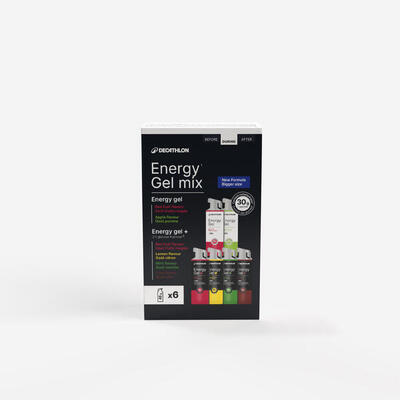
Recommended Gear
Insert the following product block into your CMS:
Plan Your Race Nutrition with Ograal
Ograal automatically plans your carbohydrate AND caffeine intake according to your target pace, with in-race reminders. Try the app at ograal.app. You can also read our article on caffeine timing before endurance events to complete your strategy.
Sources
1. Jiménez-Alfageme R et al. (2025). Nutritional Intake and Timing of Marathon Runners. Sports Med Open, 11, 14. https://doi.org/10.1186/s40798-024-00801-w
2. Spriet LL (2014). Exercise and sport performance with low doses of caffeine. Sports Medicine, 44(S2), 175-184. https://doi.org/10.1007/s40279-014-0257-8
3. Ganio MS et al. (2009). Effect of caffeine on sport-specific endurance performance: a systematic review. J Strength Cond Res, 23(1):315-324. https://doi.org/10.1519/JSC.0b013e31818b979a
4. Desbrow B et al. (2012). The effects of different doses of caffeine on endurance cycling time trial performance. J Sports Sci, 30(2):115-120. https://doi.org/10.1080/02640414.2011.632431
5. Kerksick CM et al. (2018). ISSN exercise & sports nutrition review update: research & recommendations. J Int Soc Sports Nutr, 15(1):38. https://doi.org/10.1186/s12970-018-0242-y