Two sessions in under 24 hours — that’s the defining challenge of a training block for triathletes and runners. What you eat in the 30 minutes after the first session determines up to 80% of the quality of the second. Yet most amateur athletes underestimate both the carbohydrate volume required and the critical importance of the metabolic window.
Definition: The metabolic window refers to the 0–30 minute period immediately following intense exercise, during which muscle glycogen resynthesis is maximized thanks to heightened insulin sensitivity and glycogen synthase activity 2 to 3 times above resting levels. It is the most critical nutritional opportunity for athletes completing back-to-back training sessions within 24 hours.
Ograal’s Start Time — Adapted Nutrition feature automatically calculates your carbohydrate and protein targets based on when your next session begins. During a training block, it’s the most direct lever for recovering without sacrificing session quality. Create my recovery nutrition plan on Ograal.
Key Takeaways
- 1.0–1.2 g/kg of carbohydrate within 30 minutes post-exercise maximizes glycogen resynthesis (Burke, van Loon & Hawley, 2017).
- 20–25 g of high-quality protein post-exercise maximizes muscle protein synthesis (MPS) (Churchward-Venne et al., 2020).
- A 3:1 carb-to-protein ratio addresses both glycogen resynthesis and muscle repair simultaneously between sessions.
- Delaying carbohydrate intake by 2 hours reduces resynthesis rates by 50% (Teodor & Petcu, 2026).
- 7–9 hours of quality sleep is the primary lever for neuromuscular recovery according to 2023–2024 data (Marques et al., 2023).
Glycogen: the fuel you must replenish before your next session
Muscle glycogen is the primary energy substrate during endurance exercise above 65% VO2max. After a 60–90 minute session at moderate-to-high intensity, your stores are partially to fully depleted depending on effort level. Burke, van Loon & Hawley (2017, Journal of Applied Physiology) established the reference protocol: consuming approximately 1.0–1.2 g/kg body mass in carbohydrates within the first 30 minutes post-exercise activates the biphasic resynthesis process. During the initial insulin-independent phase, glycogen synthase is activated mechanically by muscle contraction itself — no insulin is required. Absorption is therefore maximal regardless of your starting blood glucose.
Alghannam, Betts & Gonzalez (2018, Nutrients, DOI: 10.3390/nu10020253) confirmed in their systematic review that consuming ≥1.2 g/kg/h of carbohydrate over the first 4 hours of recovery maximizes muscle glycogen repletion. Below 0.8 g/kg/h, resynthesis remains incomplete, compromising the second session. For a 70 kg athlete, this means 70–84 g of carbohydrates in the half-hour after exercise — equivalent to a recovery drink, a banana and a bowl of rice.
Resynthesis occurs in two distinct phases: the rapid phase (0–4 h) with synthesis rates of 5–10 mmol/kg dry weight/h, then the slow insulin-dependent phase (4–24 h) at 1–2 mmol/kg/h. This is why a single post-session meal is insufficient — timing and total carbohydrate volume across 24 hours matter as much as the immediate window.
3 nutrition phases to recover in under 24 hours: the protocol in numbers
Completing back-to-back sessions in under 24 hours is not a question of willpower — it is a question of nutritional precision. Here is the three-phase protocol validated by the scientific literature.
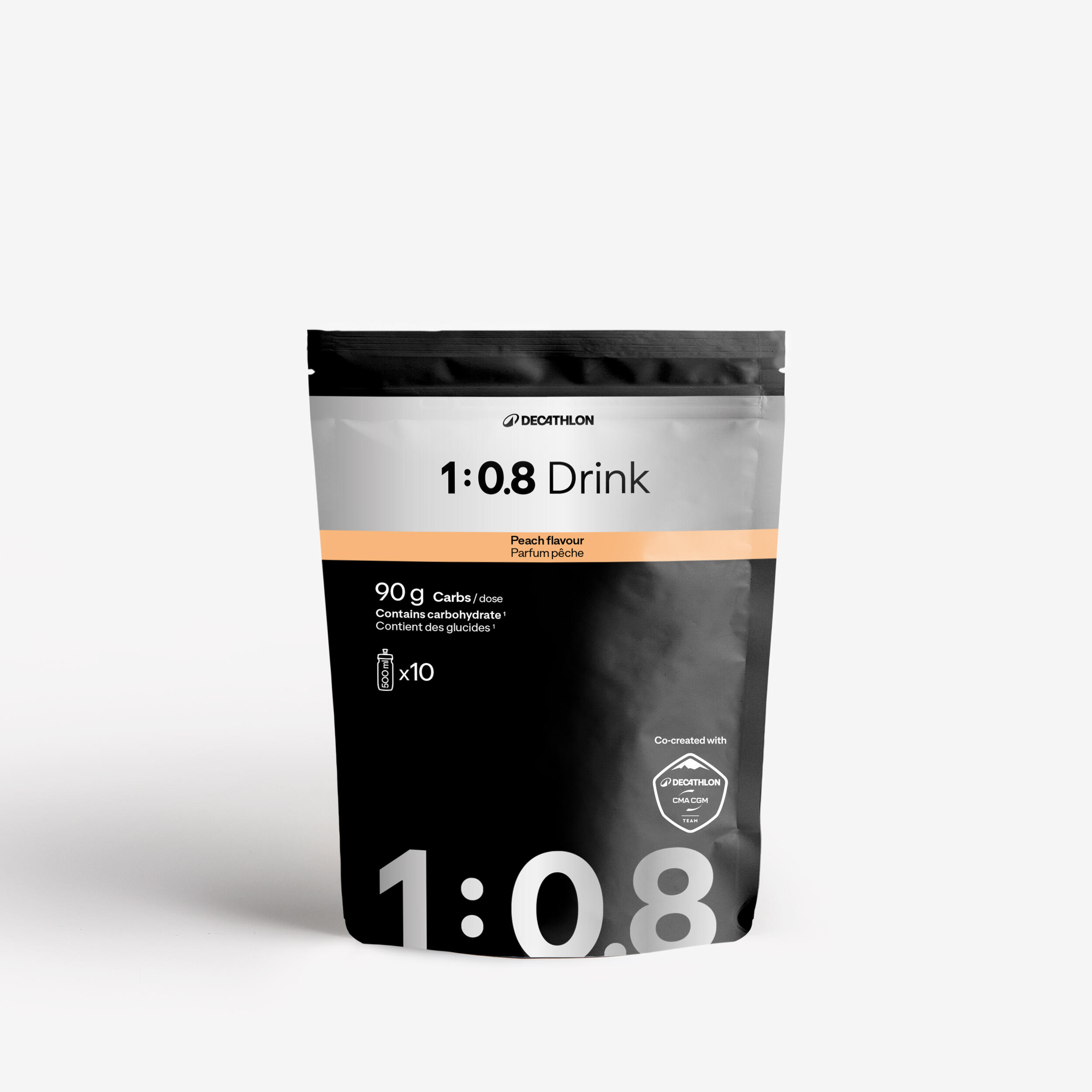
To cover Phase 1 with the ideal carb-to-protein ratio, Decathlon’s 512g Chocolate Recovery Protein Drink delivers a 3:1 ratio and 25 g of protein per serving — precisely what the literature recommends to maximize glycogen resynthesis and muscle protein synthesis between back-to-back sessions. View the recovery drink on Decathlon.
How much protein do you actually need after exercise to repair muscles between two sessions?
The answer is specific: 20–25 g of high-quality protein within 30 minutes post-exercise is sufficient to maximize muscle protein synthesis (MPS) in an adult endurance athlete. This dose was established by Churchward-Venne et al. (2020, American Journal of Clinical Nutrition, DOI: 10.1093/ajcn/nqaa073) in a dose-response study on 30 trained cyclists.
Beyond 25 g, the surplus is oxidized as urea rather than being incorporated into myofibrils. Protein quality matters as much as quantity: a leucine-rich protein source (whey, casein, whole egg) activates mTORC1, the primary regulator of MPS. For an endurance athlete completing back-to-back sessions, the goal is not hypertrophy but repair of muscle fiber micro-damage — an objective met at 20–25 g, without excess.
Co-ingesting protein with carbohydrates offers a dual advantage: the insulin stimulated by carbohydrates improves amino acid transport into the muscle, and the 3:1 carb-to-protein ratio simultaneously optimizes glycogen resynthesis and MPS. This is precisely the ratio on which the most effective recovery drinks are formulated, confirmed by Desbrow et al. (2021, Sports Medicine Open, DOI: 10.1186/s40798-020-00297-0).
To maximize absorption, distributing protein across 3–4 servings of 20–25 g over the first 12 hours of recovery is superior to a single large bolus. This distribution strategy, described by Trommelen et al. (2023, Cell Reports Medicine, DOI: 10.1016/j.xcrm.2023.101324), ensures sustained elevation of plasma aminoacidemia — the necessary condition for maintaining elevated MPS throughout the night.
For complete meal ideas optimized for recovery, see our endurance athlete recovery dinner guide.
Sleep and neuromuscular recovery: 7–9 hours as the top lever according to 2023–2024 data
Nutrition is necessary but not sufficient. Sleep is when the most decisive physiological processes occur: growth hormone (GH) secretion during deep sleep, central nervous system restoration, and consolidation of neuromuscular adaptations. A systematic review by Marques et al. (2023, Sports Medicine Open, DOI: 10.1186/s40798-023-00599-z) confirms that even a 20–45 minute sleep extension improves physical performance in the subsequent session.
During a training block, accumulated neuromuscular fatigue can persist beyond 24 hours when sleep falls below 6 hours. A study by Cabarkapa et al. (2024, Frontiers in Sports and Active Living, DOI: 10.3389/fspor.2024.1439858) found a correlation of r = −0.83 between sleep quality and lower-limb concentric force output in semi-professional athletes. Quality matters as much as duration: avoid screens for 60 minutes before bed, maintain a room temperature of 18–20 °C, and avoid caffeine after 2 PM.
For additional strategies to optimize sleep between sessions, see our article on tart cherry juice for sports recovery — a complementary approach validated for improving sleep quality in endurance athletes.
Conclusion
Completing back-to-back sessions in under 24 hours is entirely compatible with effective recovery, provided you respect three non-negotiable levers: 1.0–1.2 g/kg of carbohydrates within 30 minutes post-exercise, 20–25 g of quality protein co-ingested, and 7–9 hours of quality sleep. Timing is at least as important as quantities: missing the 30-minute immediate window cuts glycogen resynthesis rates in half. Recovery nutrition between sessions is not a comfort — it is a performance prerequisite.
Create my 24-hour recovery nutrition plan on Ograal — free access.
Frequently Asked Questions
What is the metabolic window and how long does it last?
The metabolic window is the 0–30 minute post-exercise period during which glycogen resynthesis is maximal, driven by heightened insulin sensitivity and elevated glycogen synthase activity. Beyond 30 minutes, the synthesis rate drops progressively; after 2 hours without carbohydrate intake, resynthesis slows by 50% (Teodor & Petcu, 2026, DOI: 10.61801/oua.2026.1.25).
Can you recover between two sessions using only water and protein?
No. Protein alone does not replenish glycogen — only carbohydrates directly fuel muscle glycogen resynthesis. A protein-only or low-carbohydrate recovery approach leaves glycogen stores partially depleted for the second session, degrading training quality and increasing injury risk (Alghannam et al., 2018, DOI: 10.3390/nu10020253).
Should you eat immediately after a session even when you have no appetite?
Yes. Post-exercise appetite suppression is normal — it results from catecholamine elevation that blunts hunger signals. This does not reflect the state of your energy stores. To work around this, prioritize a liquid recovery drink (easier to ingest than solids) within 30 minutes, then follow up with a solid meal 1.5–2 hours later once appetite returns naturally.
Does tart cherry juice actually help recovery between two sessions?
Yes, as a complementary strategy. Montmorency tart cherry juice, rich in anthocyanins, reduces inflammatory markers and delayed onset muscle soreness (DOMS) according to multiple randomized trials. It does not replace carbohydrates and protein but may improve sleep quality between sessions — a benefit documented in several recent clinical trials. See our full guide on tart cherry juice for sports recovery.
Sources
- Burke, L., van Loon, L., & Hawley, J. (2017). Post-exercise muscle glycogen resynthesis in humans. Journal of Applied Physiology. DOI: https://doi.org/10.1152/japplphysiol.00860.2016
- Churchward-Venne, T.A., et al. (2020). Dose-response effects of dietary protein on muscle protein synthesis during recovery from endurance exercise in young men. American Journal of Clinical Nutrition. DOI: https://doi.org/10.1093/ajcn/nqaa073
- Alghannam, A.F., Betts, J., & Gonzalez, J. (2018). Restoration of Muscle Glycogen and Functional Capacity: Role of Post-Exercise Carbohydrate and Protein Co-Ingestion. Nutrients. DOI: https://doi.org/10.3390/nu10020253
- Trommelen, J., et al. (2023). The anabolic response to protein ingestion during recovery from exercise has no upper limit in magnitude and duration in vivo in humans. Cell Reports Medicine. DOI: https://doi.org/10.1016/j.xcrm.2023.101324
- Desbrow, B., et al. (2021). The Effect of Consuming Carbohydrate With and Without Protein on the Rate of Muscle Glycogen Re-synthesis During Short-Term Post-exercise Recovery. Sports Medicine Open. DOI: https://doi.org/10.1186/s40798-020-00297-0
- Marques, E., et al. (2023). The Impact of Sleep Interventions on Athletic Performance: A Systematic Review. Sports Medicine Open. DOI: https://doi.org/10.1186/s40798-023-00599-z
- Cabarkapa, D.V., Cabarkapa, D., & Fry, A.C. (2024). Relationship between sleep quality and lower-body neuromuscular performance characteristics in semi-professional male basketball players. Frontiers in Sports and Active Living. DOI: https://doi.org/10.3389/fspor.2024.1439858
- Teodor, D. & Petcu, D. (2026). Dietary carbohydrate requirements for muscle glycogen resynthesis following exercise. Ovidius University Annals, Series Physical Education and Sport. DOI: https://doi.org/10.61801/oua.2026.1.25