Why make your own isotonic drink
If you ride or run trails with store-bought gels and sports drinks, you already know the price. Preparing your own training drink means building a carbohydrate solution calibrated to your actual effort duration, sweat rate and the day’s temperature — for around €0.30 per litre versus €3–4 for a comparable commercial product.
The difference comes down to three ingredients: maltodextrin (a complex carbohydrate with high energy density and a moderate glycaemic index), fructose (a simple sugar that uses a separate intestinal transporter, GLUT5) and table salt or mineral salt to replace sodium lost through sweat. Together they replicate exactly what commercial drinks contain — without the flavourings, colourings or distribution markup.
Ograal: calibrates every parameter for you
If you want to go beyond a generic recipe, Ograal generates a complete fuelling plan tailored to your effort duration, weather and athlete profile (weight, intensity, training habits). The app calculates the optimal carbohydrate concentration and adjusts electrolyte targets according to real-time intensity — particularly useful when you’re stacking multiple training days or preparing for your season goal. For a detailed breakdown of sodium management in the heat, read this guide on sodium and heat. If you’re targeting 90 g of carbohydrate per hour, the 6-week gut training plan walks you through the ramp-up week by week.
The 2:1 maltodextrin:fructose ratio — the science
The gut has two separate transporters for carbohydrates: SGLT1 for glucose (and its polymers, including maltodextrin) and GLUT5 for fructose. Each transporter saturates at around 60 g/h. Combining them in a 2:1 ratio (maltodextrin:fructose) unlocks both pathways simultaneously and allows you to oxidise up to 90 g of carbohydrate per hour without abdominal distension. This is the scientific basis behind every high-end multi-source sports drink.
Research on 3-hour cycling at 60% VO₂max with varying glucose-fructose [2:1] doses confirms 90 g/h as the optimal intake: beyond that threshold, transporters are saturated and time-trial performance declines. Below 2 hours of effort, this ratio is unnecessary — a single source (maltodextrin alone) is sufficient and avoids digestive complexity.
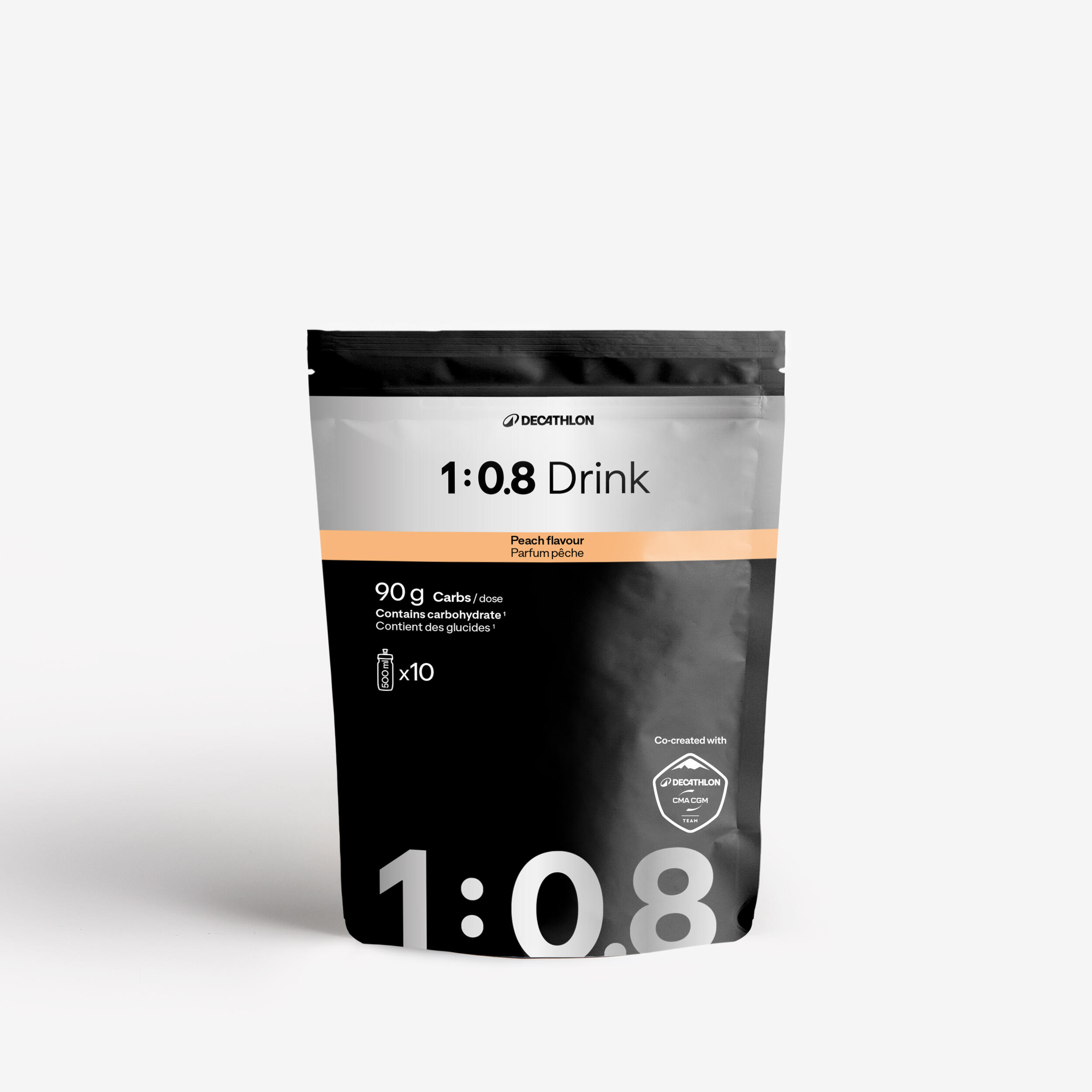
Hearris et al. (2022) compared different delivery forms (drink, gel, chew) at 120 g/h using a 1:0.8 maltodextrin:fructose ratio and recorded exogenous oxidation rates of 1.56–1.66 g/min — with minimal gastrointestinal discomfort. The liquid drink format remains the most practical for cycling, particularly for precise dosing.
Carbohydrate concentration: 4 to 8% by duration
The optimal concentration for a training drink sits between 4 and 8% (40–80 g of carbohydrate per litre of water). Below that, energy delivery is insufficient for long efforts. Above it, gastric emptying slows and digestive discomfort increases.
- < 1 h 30: 4–5% (40–50 g/L). Blood glucose is rarely an issue at this duration; the drink primarily serves hydration and mental focus.
- 1 h 30 – 3 h: 6% (60 g/L). Comfortable digestive zone with or without fructose depending on your history.
- > 3 h: 7–8% (70–80 g/L) with a 2:1 ratio. Requires prior gut training if you’re not accustomed to high carbohydrate intake.
Recipe matrix: duration × temperature
Nine base formulas for 500 ml of water (double for 1 L). All recipes use fine table salt (pure sodium chloride) or sea salt.
Quantities above are for 500 ml. For a standard 750 ml cycling bottle, multiply by 1.5. For recipes C, F and I (> 3 h), introduce fructose gradually if your gut isn’t trained — start at 10 g and build over several weeks.
Sodium: 400 to 700 mg/L depending on heat
Sodium losses through sweat range from 400 to 1,200 mg/L depending on the individual and ambient temperature. In normal conditions (< 20°C / 68°F), 400–500 mg of sodium per litre is sufficient. Between 20 and 28°C (68–82°F), aim for 500–600 mg/L. Above 28°C (82°F) — or if you sweat heavily — increase to 700 mg/L or more to prevent hyponatraemia and maintain plasma volume. For a deeper dive into salt management by sweat rate, the Ograal article on sodium and heat is a useful reference.
Practical conversion: 1 g of table salt (NaCl) ≈ 393 mg of sodium. To reach 700 mg of sodium in 1 L, you need approximately 1.78 g of salt — a generous pinch on a kitchen scale.
What does it really cost? The numbers
Cost breakdown for 1 litre of standard training drink (60 g carbohydrate, 500 mg Na):
- Maltodextrin: 40 g × €0.004/g = €0.16
- Fructose: 20 g × €0.003/g = €0.06
- Table salt: 1.2 g ≈ < €0.01
- Homemade total: ~€0.23–0.30/L
For comparison, a commercial isotonic powder drink typically costs €3–4/L depending on the brand and recommended dilution. Over 100 two-hour sessions with 1 L of drink each, the gap represents €270–370 in savings.
Commercial reference: Decathlon ISO+ neutral powder 650 g
The Isotonic drink powder ISO+ neutral 650 g by Decathlon offers a balanced maltodextrin + minerals formula, useful for benchmarking your homemade version against a commercial reference. For comparison: approximately €3–4/L depending on the recommended dilution.
Preparation: 3 minutes the night before
Mix your drink the evening before or the morning of your session. Maltodextrin and fructose dissolve easily in room-temperature water with 30 seconds of shaking. For efforts over 3 hours, pre-dissolve in 300 ml then top up to 500 ml — this prevents clumping.
- Weigh your ingredients on a kitchen scale (1 g precision).
- Pour into the bottle, add half the water, shake for 15 seconds.
- Top up to final volume, shake again for 15 seconds.
- Keep refrigerated until departure, no more than 12 hours.
Avoid adding lemon or citrus juice directly to the bottle in hot conditions: the acidity can interfere with maltodextrin dissolution and reduce solution stability.
Gut training: prepare your gut before big goals
Absorbing 90 g/h of carbohydrate is not something to improvise. Gonzalez et al. (2017) show that digestive tolerance to high carbohydrate doses improves with consistent training — this is known as gut training. If you’re targeting your season goal with high-intensity fuelling, start at 45–60 g/h and build progressively over 4–6 weeks. The Ograal 6-week gut training plan at 90 g/h outlines this week-by-week progression.
Sources
[1] Fuchs CJ, Gonzalez JT, van Loon LJC. Fructose co-ingestion to increase carbohydrate availability in athletes. J Physiol. 2019. https://doi.org/10.1113/JP277116
[2] Gonzalez JT, Fuchs CJ, Betts JA, van Loon LJC. Glucose Plus Fructose Ingestion for Post-Exercise Recovery. Nutrients. 2017;9(4):344. https://doi.org/10.3390/nu9040344
[3] Hearris MA et al. 13C-glucose-fructose labelling reveals comparable exogenous CHO oxidation during exercise when consuming 120 g/h. J Appl Physiol. 2022. https://doi.org/10.1152/japplphysiol.00091.2022
[4] King AJ et al. Liver and muscle glycogen oxidation and performance with dose variation of glucose-fructose ingestion during prolonged (3 h) exercise. Eur J Appl Physiol. 2019. https://doi.org/10.1007/s00421-019-04106-9