Creatine Is Not Just for Bodybuilders
On April 12, 2026, Wout van Aert crossed the cobbles of Paris-Roubaix carrying the memory of a shattered ankle — fractured in January, rehabilitated in six weeks through an intensive cycling recovery program that left the sports world stunned. That day, he fueled at 120 g of carbohydrates per hour, answered every surge on the paved sectors, and lifted the trophy in Roubaix. His athlete profile — explosive repeated efforts, ultra-fast recovery between back-to-back Spring Classics, monument after monument — is precisely the use case that makes creatine relevant in endurance sport. Van Aert almost certainly doesn’t supplement with creatine (no data supports it), but his cobbled classicman profile is the textbook example: short maximal efforts, repeated within a compressed racing block, with rapid recovery windows in between. That’s exactly where the science points.
Creatine has long been pigeonholed as a supplement for gym-goers and powerlifters. That’s a persistent misconception — and largely inaccurate. Creatine is a naturally occurring compound in muscle tissue, central to the rapid regeneration of ATP via the phosphocreatine (PCr) system. In plain terms: it allows your muscles to sustain high output during short, intense efforts.
In endurance sports, ATP is predominantly produced by the aerobic system. But every time you attack a climb, sprint for the line, or respond to a surge in the peloton, you also call on the PCr system. That’s where creatine becomes relevant. A major meta-analysis by Forbes et al. (2023) — DOI: 10.1080/15502783.2023.2204071 — confirms that creatine can improve performance during repeated high-intensity efforts, including in endurance contexts.
What Ograal Can Do for Your Recovery
For creatine to do its job, it needs help getting stored effectively in the muscle. And nutrition plays a key role here. Co-ingestion of creatine with carbohydrates (and protein) significantly improves muscular uptake — a detail many endurance athletes overlook.
That’s exactly where Ograal helps concretely:
- Meal plan calibrated gram by gram to your daily effort level
- Optimized post-workout snack: the right carbohydrates at the right time to maximize glycogen replenishment — and creatine absorption
- Carbohydrate intake tracking throughout the day, essential when managing double sessions or loading blocks
- Double-session management: the app accounts for both recovery windows in your nutritional planning
As Ingrid points out on nutrisport.diet, the post-workout window is critical for muscle recovery and glycogen reloading. Ograal helps you structure that window with precision, whether you’ve just finished a long aerobic session or an intense interval block.
See also our guide on recovery nutrition for endurance athletes and the article on omega-3 for endurance sport to build out your full nutritional strategy.
With Ograal, plan your recovery nutrition and carbohydrate intake — the ideal conditions to get the most out of your creatine supplementation. Get started at https://ograal.app
Real Benefits for Endurance Athletes
Let’s be straight: creatine is not a universal performance enhancer for all endurance formats. But in specific situations, the evidence is solid.
Cycling is the most favorable terrain. The added body weight from water retention (1–2 kg) is far less penalizing on a bike than on foot — especially on a flat or rolling course. Tomcik et al. (2018) — DOI: 10.1249/MSS.0000000000001401 — observed a 10–15% improvement in final sprints among elite cyclists following a creatine protocol combined with carbohydrate loading. In a criterium or a sportive with a sprint finish, that margin can be decisive.
In triathlon, the benefits are most apparent on the bike leg and during high-intensity transitions. Engelhardt et al. (1998) — DOI: 10.1097/00005768-199807000-00012 — measured an 18% improvement in repeated high-intensity interval capacity among creatine-supplemented triathletes. That data speaks for itself.
In running, the picture is more nuanced. Trail surges, mid-race accelerations, finishes in a 10K or half-marathon — all situations where the PCr system is called upon. But the water weight gain requires additional consideration, especially for pure marathon runners.
Important Nuances (Honest Assessment)
Creatine has real benefits — but not without conditions. Here’s what the research actually says.
- Water weight gain of 1–2 kg at the start of the protocol: unavoidable, caused by intramuscular water retention. Fully reversible when you stop.
- Impact on relative VO2max (body-weight-adjusted): potentially negative if you run on road or track, where every gram matters.
- No demonstrated effect on pure aerobic performance: the oxidative system is not directly affected by creatine.
- Not recommended during peak competition phases if you’re racing a marathon or ultra: even temporary weight gain can compromise your running economy.
These nuances are clearly documented in the Forbes et al. (2023) meta-analysis — DOI: 10.1080/15502783.2023.2204071 — which distinguishes athlete profiles for whom creatine provides a clear net benefit from those where the benefit-to-risk ratio is less favorable. The key: know your profile and your race calendar.
Practical Supplementation Protocol
No loading phase with massive doses required. The current evidence is clear on this.
- Dose: 3–5 g/day of creatine monohydrate
- Duration: minimum 4–6 weeks to saturate muscle creatine stores
- Timing: after training, with your post-workout meal or snack rich in carbohydrates — to maximize absorption
- Co-ingestion: combine with carbohydrates (50–100 g) and ideally protein — this is the optimal combination for muscular storage
- Competition phase: avoid starting a new protocol 2–3 weeks before an A-race where body weight is critical
- Periodization: use creatine during build or volume blocks, not in your peak form phase
Rawson & Volek (2003) — PMID: 14636102 — showed that 5 g/day without a loading phase produces results comparable to loading protocols over 4 weeks, with fewer gastrointestinal side effects. Comfort and efficacy — no need to overcomplicate it.
Who Does It Actually Benefit?
An honest breakdown of the endurance athlete profiles for whom creatine makes the most sense:
High benefit potential:
- Cyclists with frequent surges, climbs, or repeated high-intensity efforts (criterium, gran fondo, gravel racing)
- Triathletes at Olympic or Ironman 70.3 distance, especially when the bike leg is explosive
- Runners in the 5K–half marathon range with sprint finishes
- Road cyclists in a winter base or build phase
Less favorable benefit-to-risk ratio:
- Pure marathoners focused on running economy
- Ultra-trail runners where weight is a decisive factor over long distances
- Athletes within 3 weeks of a major A-race
In Practice: How to Take It
The form matters as much as the dose. Here are the non-negotiables:
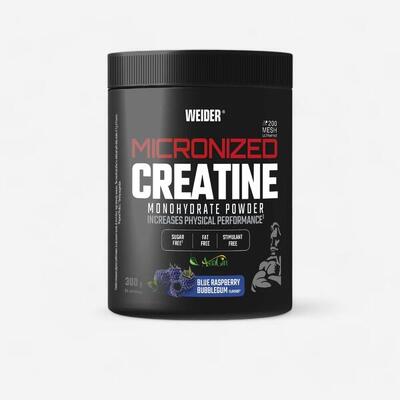
- Form: creatine monohydrate only — the best-validated form scientifically, the most studied, and the most affordable. “Advanced” forms (ethyl ester, creatine HCl) show no superiority in studies.
- Solvent: warm water or fruit juice — creatine dissolves better in warm liquid, and the glycemic index of fruit juice facilitates absorption
- Optimal timing: after training, with your recovery snack or meal
- Daily dose: 3–5 g/day (no more needed)
- Cycle length: 4–8 weeks, then a 4-week break — or continuous use (both approaches are validated in the literature)
- During supplementation: slightly increase daily hydration (+300–500 ml/day)
Our Pick
Sources
1. Forbes SC et al. (2023). Creatine supplementation and endurance performance: surges and sprints to win the race. J Int Soc Sports Nutr, 20(1):2204071. https://doi.org/10.1080/15502783.2023.2204071
2. Tomcik KA et al. (2018). Effects of creatine and carbohydrate loading on cycling time trial performance. Med Sci Sports Exerc, 50(1):141-150. https://doi.org/10.1249/MSS.0000000000001401
3. Engelhardt M et al. (1998). Creatine supplementation in endurance sports. Med Sci Sports Exerc, 30(7):1123-1129. https://doi.org/10.1097/00005768-199807000-00012
4. Jiménez-Alfageme R et al. (2025). Nutritional Intake and Timing of Marathon Runners. Sports Med Open, 11, 14. https://doi.org/10.1186/s40798-024-00801-w
5. Rawson ES & Volek JS (2003). Effects of creatine supplementation and resistance training on muscle strength and weightlifting performance. J Strength Cond Res, 17(4):822-831. PMID: 14636102